
Securitization without Security:
How Migration is Shaping the Global Order
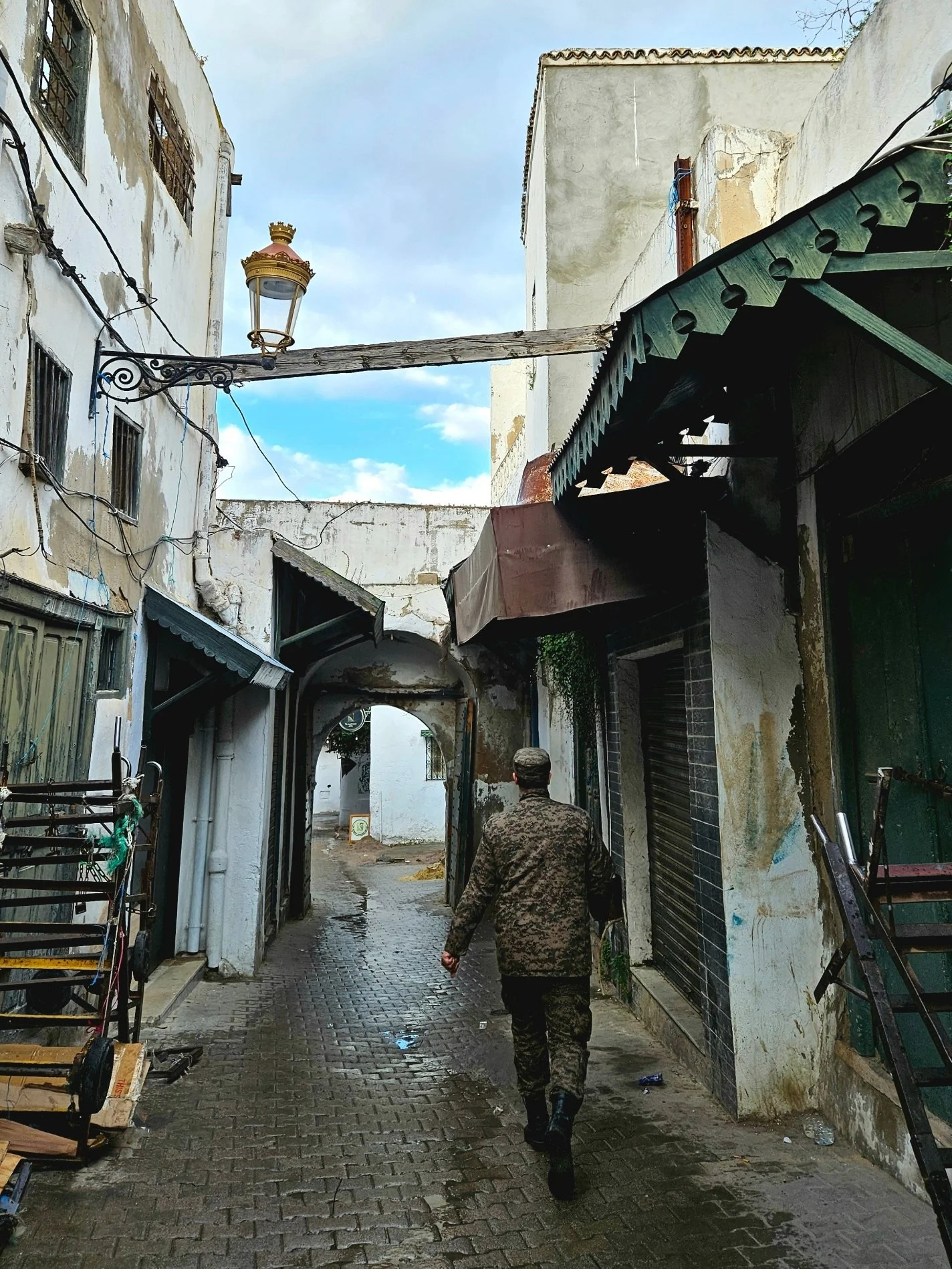
notes from the field - Tunis #2
Living without Legal Migratory Status Under Compounding Pressures
Author: Andrew Fallone
Location: Tunis, Tunisia
Date: March 31, 2026
It is not easy to move around Tunis without legal migratory status when you also carry multiple visual markers of difference. For this reason, when meeting with Black trans women on the move, I chose to go close to where they live. Even if access to public life is always complicated in a country where homosexuality is formally criminalized and where xenophobic rhetoric against sub-Saharan African people on the move is promulgated from the upper echelons of public office, at least meeting in people’s neighborhoods avoids the challenges of finding a taxi driver who is willing to serve them. Public transit is out of the question; there are too many variables, from random migration document checks to targeted physical violence and harassment.
The clearest sign that access to public life is restricted is the text of “je ne trouve pas un coin ici vraiment” that I get in reply when I ask a friend if there is any café where she feels comfortable close to where she lives, “I really can’t find anywhere here.” When we do meet, she tells me that she spends most of her time at home. While many people on the move in Tunisia’s informal economy spend more than 12 hours at work every day, the Black trans women I know tell me that they can’t work. One woman tells me that “the clients will see me, and they won’t be happy.” Another tells me that “for the Trans community, there are no job opportunities.” Life spent not working should not be conflated with an easy life, “you’re blocked everywhere. Even in your daily life, you can’t move around. You’re stuck. You’re always in your apartment. You can’t go out. You can’t leave.” Without access to work, one woman tells me that “even just having enough to eat isn’t easy.”
The visibility of stigmatized identity markers amplifies the differential treatment of people on the move in the public sphere. A lack of income compounds with taxing premiums, as I am told by one woman that when she goes to a market, “I’m refused service, or they raise their prices to serve me.” Perhaps such premiums are not charged out of targeted enmity, but simply due to power asymmetries that mean that sellers can charge a few extra dinars. The same power asymmetries that mean that Black trans women without legal migratory status have little option to contest the prices they’re charged.
As we chat, a woman and her partner tell me that they don’t claim ownership of grand aspirations, she says “we are very quiet. We don’t bother them. We just want to live a life, a peaceful life.” She goes on to say that some people’s assumptions about her, based on her skin-color, in combination with her migratory status and sexuality, prevents her from living the life she described. “The fact that you're Black is a deal-breaker,” she tells me. Black Tunisians’ longstanding presence and integral contributions to the country’s cultural heritage and traditions, with revered musical traditions such as stambeli rooted in Black Tunisian identity, doesn’t seem to factor into the treatment that multiple Black trans women on the move describe experiencing. Another woman I met with the following day tells me that “I can’t go out to the market. Because when I go to the market, I often get attacked, so I can’t go out all the time.”
These manifold examples should not lead one to believe that prejudice is ubiquitous, with one woman telling me about Tunisian mothers giving her a blanket and bread when she was previously homeless and sleeping on the streets in Tunis. But in her next breath, she tells me about stones being thrown at her.
A lack of documentation among people on the move further restricts the limited access to the public sphere that people experience, because it heightens the costs incurred if people are apprehended in summary document checks. It also limits access to justice, by precluding people who experience targeted violence based on their sexual identity or skin color from reporting it to local authorities, for fear that they will be asked to demonstrate legal migratory status.
The women I speak to tell me that International Organizations and local civil society were a main lifeline, but that such support recently became out of reach. One organization provides small hygiene kits. Another woman who is HIV positive tells me that another organization providers her with AIDS medication, but that she pays for her hormone therapy out of her own pocket, and that costs are going up. When I ask about what other forms of support are available, one woman tells me “before, there were community organizations here. But now, after the president’s decree [in February 2023], all the organizations are closed. All the organizations that helped the [LGBTQIA+] community are closed.”

Access to quasi-formal documentation is a sticking point. When speaking with a woman and her partner, she tells me that she has a UNHCR had issued her a ‘demande d’asile’ card when she first arrived in Tunisia and registered with them. This card is not part of a formal asylum process, because, despite acceding to the 1951 and 1967 UN Refugee Convention and Protocol, Tunisia does not have a legal path for people on the move to claim asylum. Still, such cards provide a form of documentation that people can show if stopped by local authorities. My friend tells me that she was recently stopped by the police, and, upon showing her card from the UNHCR, she was let go after paying a 20TND bribe. Her partner, though, arrived in Tunisia more recently, and he wasn’t able to receive a card because, as she explains “now, when you arrive…they’ve already stopped taking registrations at the UNHCR.” This cessation of registrations and her partner’s consequent lack of this quasi-official card means that what was a random stop and bribe for her could have turned into imprisonment for her partner.
Another Black trans woman on the move tells me she and her partner were both arrested after police came to her house. While she was released the following day, because she has a ‘demande d’asile’ card, her partner was imprisoned for two months for his lack of legal migratory status.
As we speak, she explains to me that her phone has broken. It won’t connect to her SIM card, so she can’t receive calls. Such connectivity is crucial, because that SIM card is the phone number that the UNHCR has to contact her, in the event that it ever becomes possible for her to be resettled to another country, like Canada. Yet, she says “I can't afford a new phone right now. I have to eat first, not pay for a phone.” I ask her about what she will do if she isn’t given the chance to participate in official resettlement. She tells me “there is no Plan B.”