
Securitization without Security:
How Migration is Shaping the Global Order
notes from the field - Tunis #1
Working in an Economy Under Pressure
Author: Andrew Fallone
Location: Tunis, Tunisia
Date: March 30, 2026

Although people on the move without ‘regular’ migratory status in Tunisia lack the formal right to work, people must still work to earn a living. The informally economy is sizeable, and provides income for many people on the move in Tunisia, yet access to decent work is scarce and employee protections against accidental injury or wage theft are nonexistent. For some non-Tunisians working in Tunisia’s informal economy, the limited income that this work provides was the goal of their journeys. Many others, however, find themselves unexpectedly waylaid and working in precarious positions after their hopes of continuing onwards from Tunisia failed to materialize.
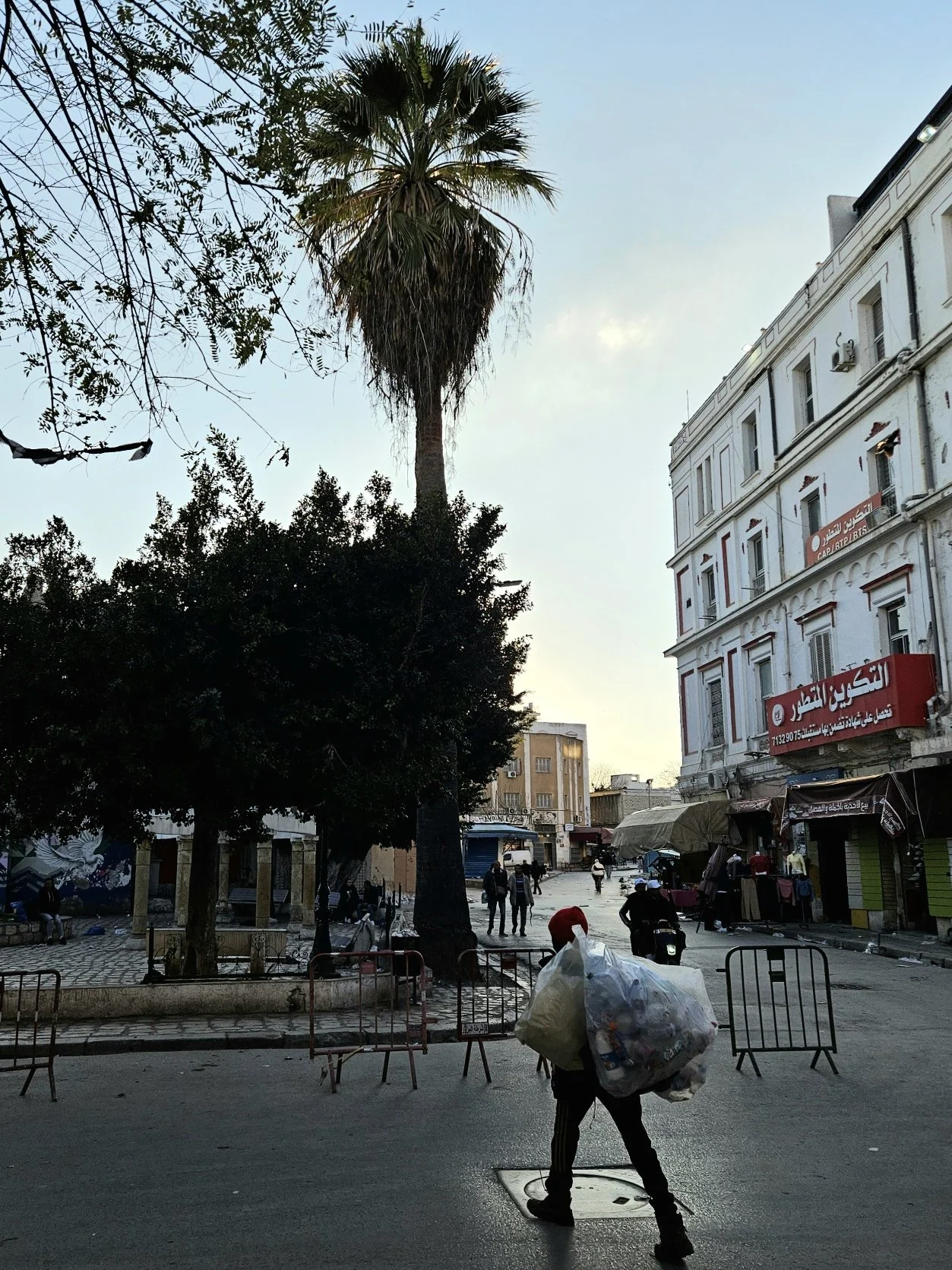
One would be hard-pressed to visit a large construction site across Tunis and not encounter people on the move working there. In the wealthier neighborhoods of La Marsa, Carthage, Lac, and Sidi bou Saïd, where foreign diplomats and members of the international community from the Global North often live, nannies without legal migratory status are also frequently employed. One of the most readily accessible, and lowest paid, forms of income generation is collecting plastic bottles or cardboard to sell to recycling centers, for which people tell me they earn roughly 10TND (~$3) for a long day of work.
The presence of people on the move in the Tunisian economy is an open secret. A senior diplomat at a sub-Saharan African nation’s embassy told me that she was recently tempted to surreptitiously snap a picture of a Tunisian police car being washed by three men without legal migratory status, due to the blatant hypocrisy of the situation: while their presence may be anathema, their affordable labor is welcome.
Spatial centrality often shows an inverse correlation with the visibility of non-Tunisian’s work. In restaurants in Centreville, people on the move more frequently work in less visible positions, washing dishes in the back or cleaning after restaurants close. In these more central environs, the people on the move making a living who are visible are mothers with young children begging in high foot-traffic areas, and their visibility makes them more susceptible to sporadic immigration enforcement, should it occur.
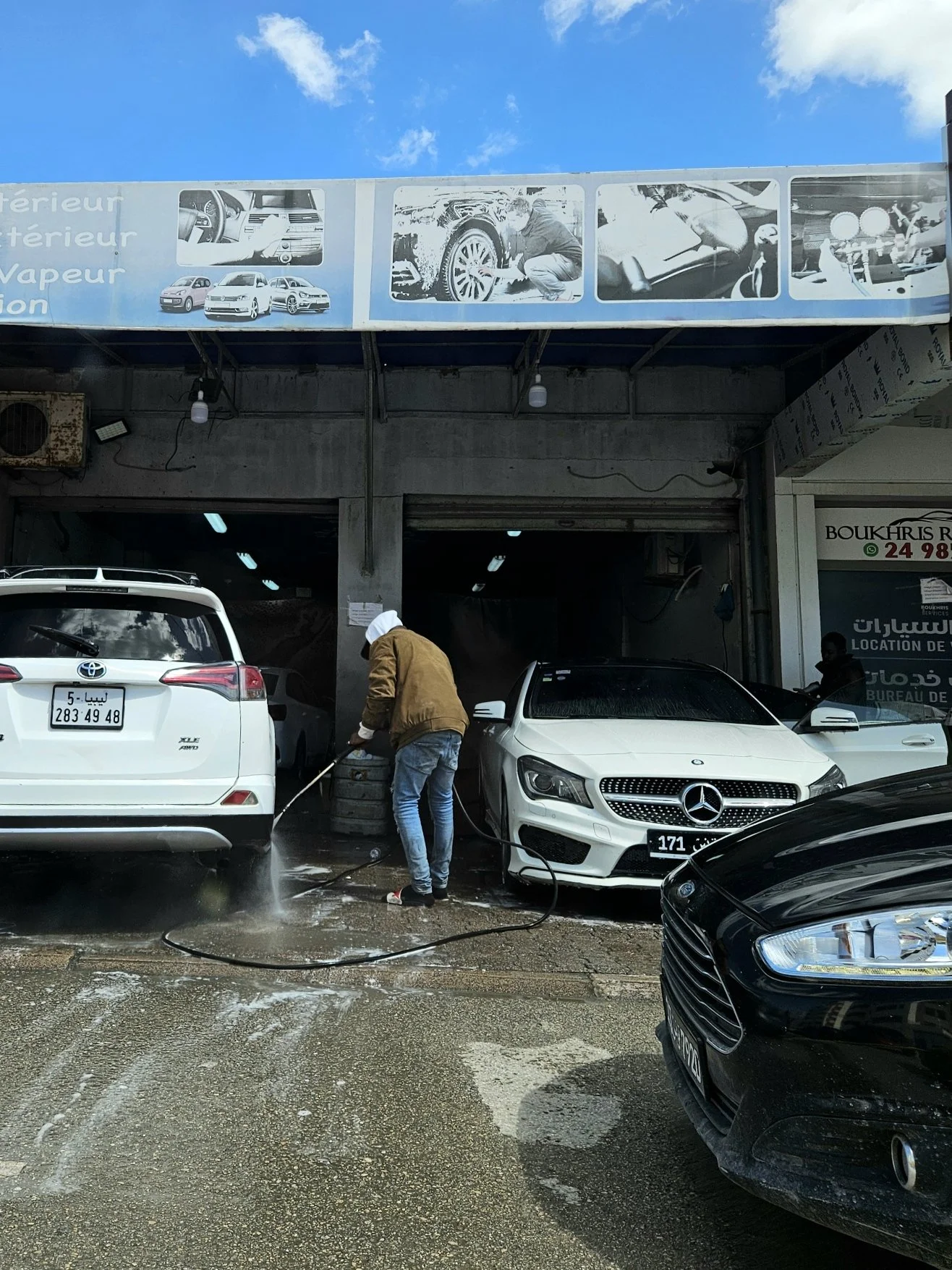
The gendered dimension of migration enforcement also catalyzes changes in familial breadwinner dynamics. People tell me of apparent targeting of Black men, specifically, in migration status checks. Domestic tensions can arise among displaced families resulting from women working as nannies or maids while their male partners describe feeling almost trapped at home. In the urban periphery, such as El Aouina, Ariana, and La Soukra, people on the move occupy more visible roles in the economy, sometimes working as servers in cafés or assistants in garages. However, these peripheral locations where higher concentrations of people on the move work and live are also where immigration enforcement actions such as raids and document checks are more likely to occur.
It would be wrong to say that there is pervasive animosity towards non-Tunisians without legal status working in the Tunisian economy, with one Cameroonian man introducing me to his Tunisian colleagues in a café in Ennassr as they laugh and joke together. Yet, it is undeniable that migratory status influences power dynamics in Tunisian workplaces. A Syrian man without legal status, who is able to work in a more visible role closer to the urban center due to his white skin and his Arabic fluency that many francophone West African people on the move lack, explained his employment situation and his difficult relationship with his boss to me. To keep his job, he must work 14 hours days, six days each week, for which he is paid between 700 and 750 TND total per month (~$250), depending on tips. He rents a room that is an hour’s walk from his workplace, and pays 600TND per month, without a formal rental contract, because such an official agreement is impossible without legal migratory status. He carefully allocates the remaining 100 – 150 TND (~$35-50) to ensure it lasts the whole month, eating one meal each day, consisting of two eggs and a piece of bread. For him, this wage is still an improvement from the previous wage he earned of 10TND (~$3) per day, or 300 TND (~$100) per month.
While we are speaking, his boss calls him and tells him that he will need to come back and work an extra 30 minutes, because he had arrived 15 minutes late that morning. He tells me that his precarity gives him insomnia, as he cannot sleep at night because he worries about his future, so he had trouble leaving his house at 6am that morning to arrive at work by 7. He opens his phone and shows me a long string of messages from his boss, chastising him for having left an ashtray on a table after a customer left. He says he can’t contest these unreasonable demands, because he is afraid to lose job. He tells me about a period when he was homeless, after a previous housing arrangement unexpectedly evaporated. He had asked his boss to allow him to sleep in the café for a day or two until he could find a new place to live. His boss told him that he could not permit him to sleep there, so he slept on the street.
In the current Tunisian economy, many Tunisians themselves also work under pressure. A Tunisian server in a café in the medina tells me that he works seven days per week, for 30 TND per day (~$10), but he is permitted to sleep in the café where he works at night. He bemoans to me that the grand majority of the Tunisian economy is controlled by a small number of unimaginably wealthy families. While we chat, another Tunisian man overhears our conversation and stands up from his table to walk over and show me his Italian ID card from his own journey. A different Tunisian bricklayer who had previously crossed the Mediterranean to Italy before being deported earns the same salary of 30TND per day. Harraga (حراقة), the derja word for burning that refers to both a burning desire to leave and physically burning one’s identity documents before departing, is intractably linked to people’s perceived paucity of economic opportunity.
An expert in Tunisian political science tells me that the economy is the number one issue for many Tunisians, who increasingly become disillusioned with failure of the current administration’s promises of anti-corruption campaigns to materialize into economic benefit. Another Tunisian scholar tells me that Tunisia used to be known for “the best sugar, meat, and vegetables, we used to be a number one destination for medical tourism.” He said that now, as well-paying employment is difficult to find and wages fail to keep up with rising costs, people to consider having basic necessities a luxury.
Everyone is talking about rising costs of living. One taxi driver tells me that he would have more children, if the cost of living wasn’t so high. Another taxi driver tells me that had divorced and that he would re-marry, if he had enough money, but it is hard to save enough to re-marry with rising costs. This focus on personal economic struggles can mean that people focus less on the government’s treatment of migrant populations, on the repression of civil society groups, and on the restriction of civil liberties.
The day I arrived in Tunis, a group of long-term unemployed university graduates held a small demonstration in the Kasbah. The following Saturday, a Tunisian rapper turned purveyor of xenophobic vitriol led a protest in the city center calling for the expulsion of non-Tunisians from the country. Yet, it is far easier to decry the presence of non-Tunisians than it is for such non-Tunisians to depart. In conversation, I hear that some sub-Saharan African people who had entered Tunisia on visas and overstayed would like to leave, based on the rising tenor of xenophobic rhetoric, but that the current economic pressure means that they cannot afford the visa-overstaying fee that they will be charged when trying to exit.
As I sit on a park bench outlining these fieldnotes, a small dog in a jacket comes over to me and sniffs my leg. I briefly chat with the dog’s owner about his pet, before he continues his walk. Twenty minutes later, the same man returns and greets me. He introduces the young woman who is now walking beside him to me as his daughter, Amel, and hands me her business card. “Let her know if you know have any good jobs for her!” he calls out in derja with a smile and wave.