
Securitization without Security:
How Migration is Shaping the Global Order
notes from the field - Basmane
Changing Dynamics - Basmane
Author: Samet Apaydın
Location: Basmane, Izmir
Date: December 1, 2025
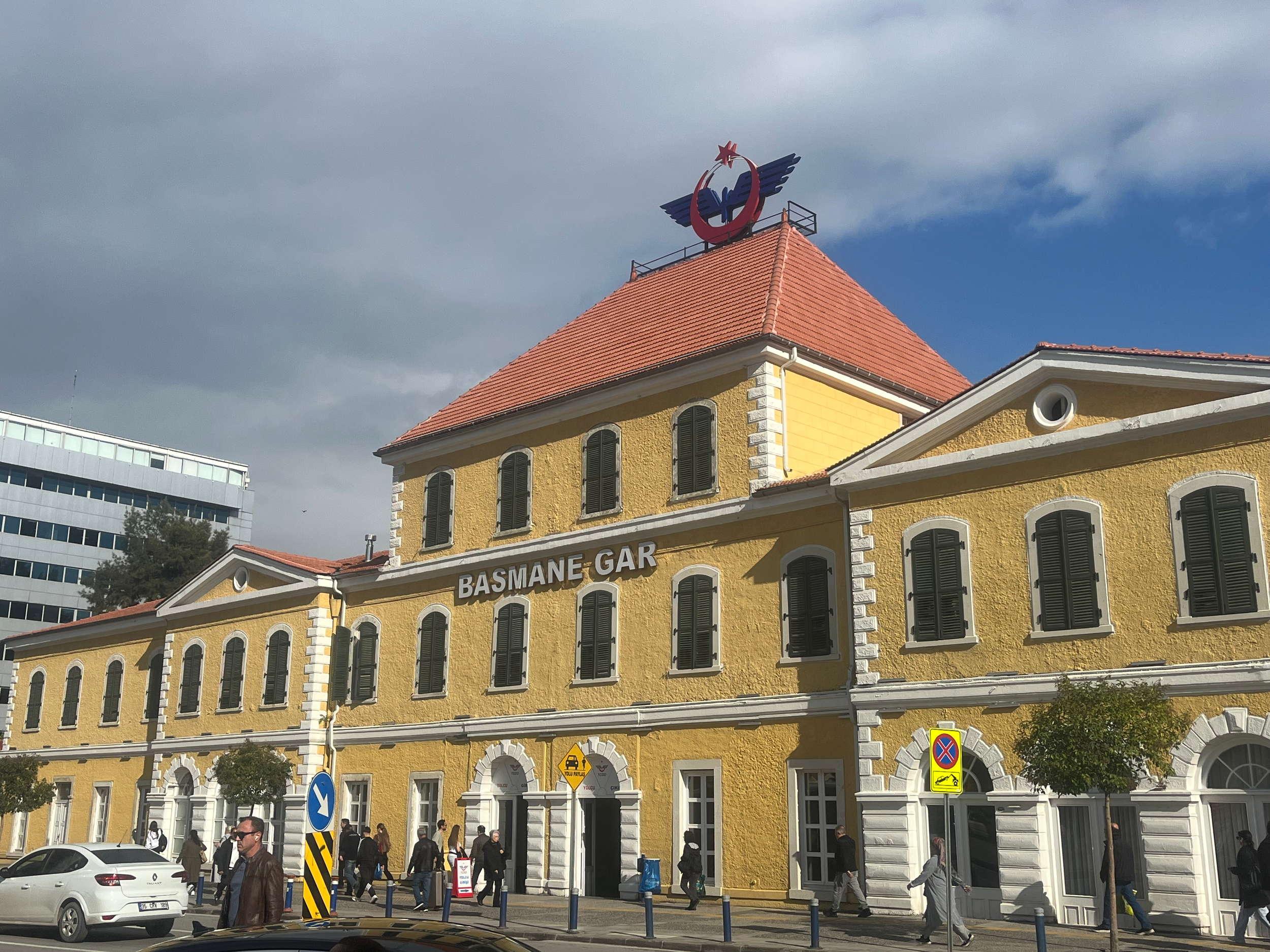
Upon arriving in Izmir for this round of fieldwork, I immediately made my way to Basmane, a district long known for its layered history and complex social structure. The neighborhood’s already mixed culture has already begun to transform with the opening of the railway station in 1866, which turned Basmane into an important point of mobility and commercial exchange in the city. Over the following decades, the area developed into a diverse residential zone that attracted mostly Jewish and Armenian communities, whose presence shaped much of its cultural and architectural character. This multicultural legacy remained visible even after the large fire of 1922, which destroyed much of the district and changed its demographic profile. Today, although many things have shifted, traces of this past can still be seen in the churches, historical buildings, and the old Jewish “kortijos”. Residents from different countries still live in the district, but the overall socio-cultural composition has changed significantly over time.
Migration Driven Transformation
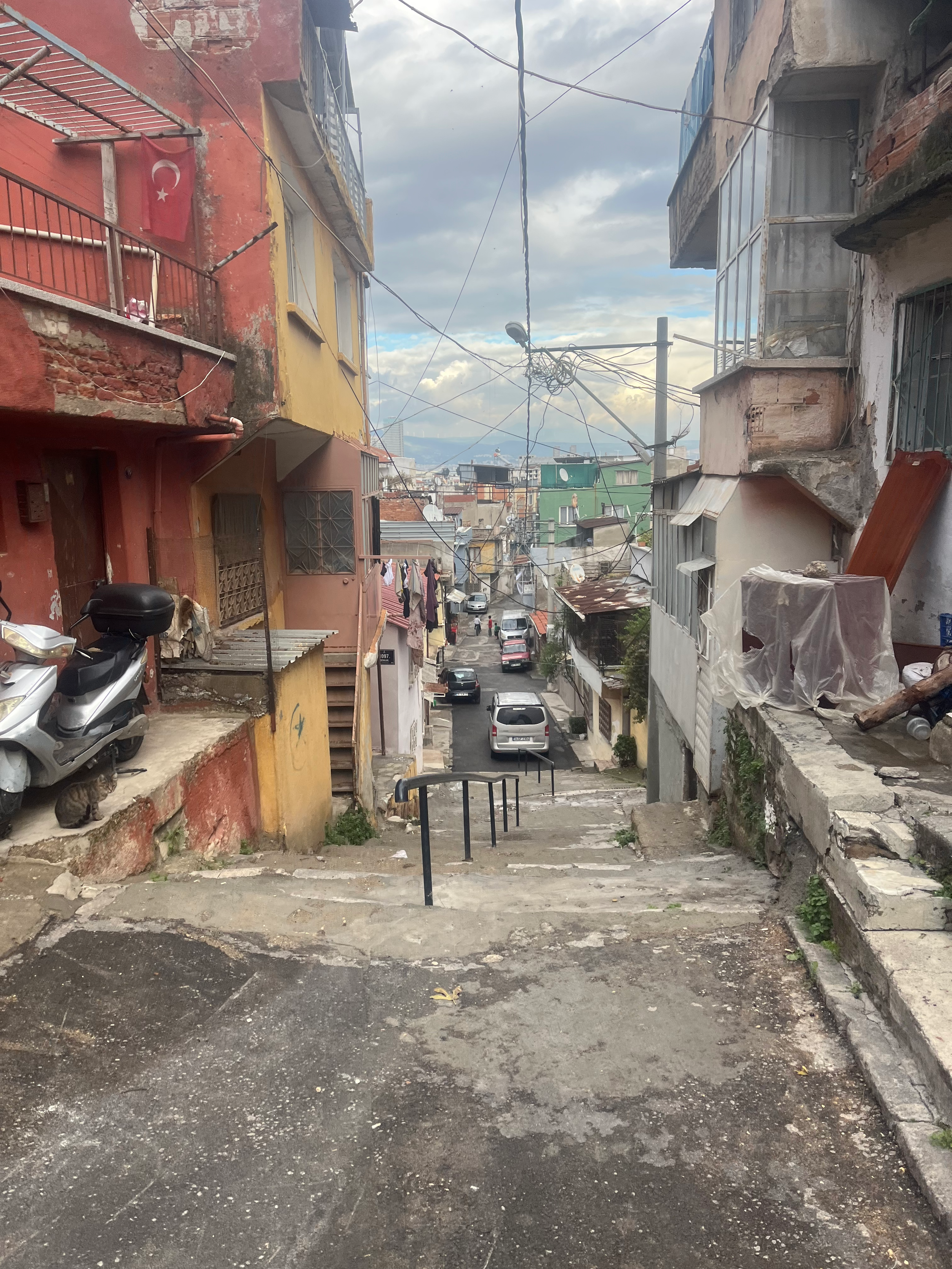
In recent years, Basmane has been strongly shaped by broader migration dynamics. As noted in the previous fieldwork entry (#10), Izmir’s geographical position has made the city a key hub for irregular migration, and Basmane is where many of these processes become visible. Local residents often refer to parts of the neighborhood as the “Syrian neighborhood”, and during my visit I rarely heard Turkish spoken on the streets. Newly (not so) arrived migrant communities have become part of the district’s daily rhythm, visible in its commercial activities and in social interactions.
Housing conditions provide another visible marker of the area’s transformation. Almost all residential buildings are decades old, and many have suffered from long term neglect. This is particularly striking given Izmir’s exposure to earthquakes. The 2020 Aegean earthquake, for example, caused the loss of 117 lives in the city. Despite these risks, local interlocutors stated that large scale urban renewal efforts remain unlikely. They attribute this to the current economic crisis and to persistent political tensions between central and local authorities, which hinder coherent planning initiatives. The photographs I took show this clearly, with houses in different stages of deterioration and some reduced to partial ruins.
Demographic Shifts and Everyday Interactions
Local authorities and long-term residents noted that the arrival of Syrians has accelerated the departure of Turkish citizens from Basmane. This is important because the district is centrally located and close to many workplaces in Izmir. In theory, civil servants and white-collar workers could benefit from living in such an accessible area. In practice, almost none of the current residents are Turkish citizens. The demographic shift is therefore visible not only in official data but also in the everyday life of the neighborhood.
Beyond these structural and demographic transformations, the everyday spatial practices observed in Basmane further illustrate how the neighborhood has become a node in broader migration trajectories. Daily interactions along the narrow streets showed a constant flow of people whose origins and legal statuses differ, yet who share similar patterns of mobility and precarity. In many encounters, it was difficult to distinguish Syrians from Afghans, as residents themselves often mentioned. The reliance on Arabic or a mix of Arabic and rudimentary Turkish for communication adds to this ambiguity. Many shops and small businesses now display Arabic signage, offering services ranging from mobile phone to tobacco shops, showing how the commercial sector has adapted to the needs of migrant groups who may want to stay long in the area.
Urban Decay and the Changing Built Environment
Another visible pattern is the presence of Black African migrants, who seem to occupy a different social position in the neighbourhood. Some work in informal street economies, while others described overcrowded living conditions and irregular access to employment. Their experiences add another layer to Basmane’s migrant population and show how vulnerabilities differ between groups. For many, Basmane functions as a temporary stop rather than a long term home.
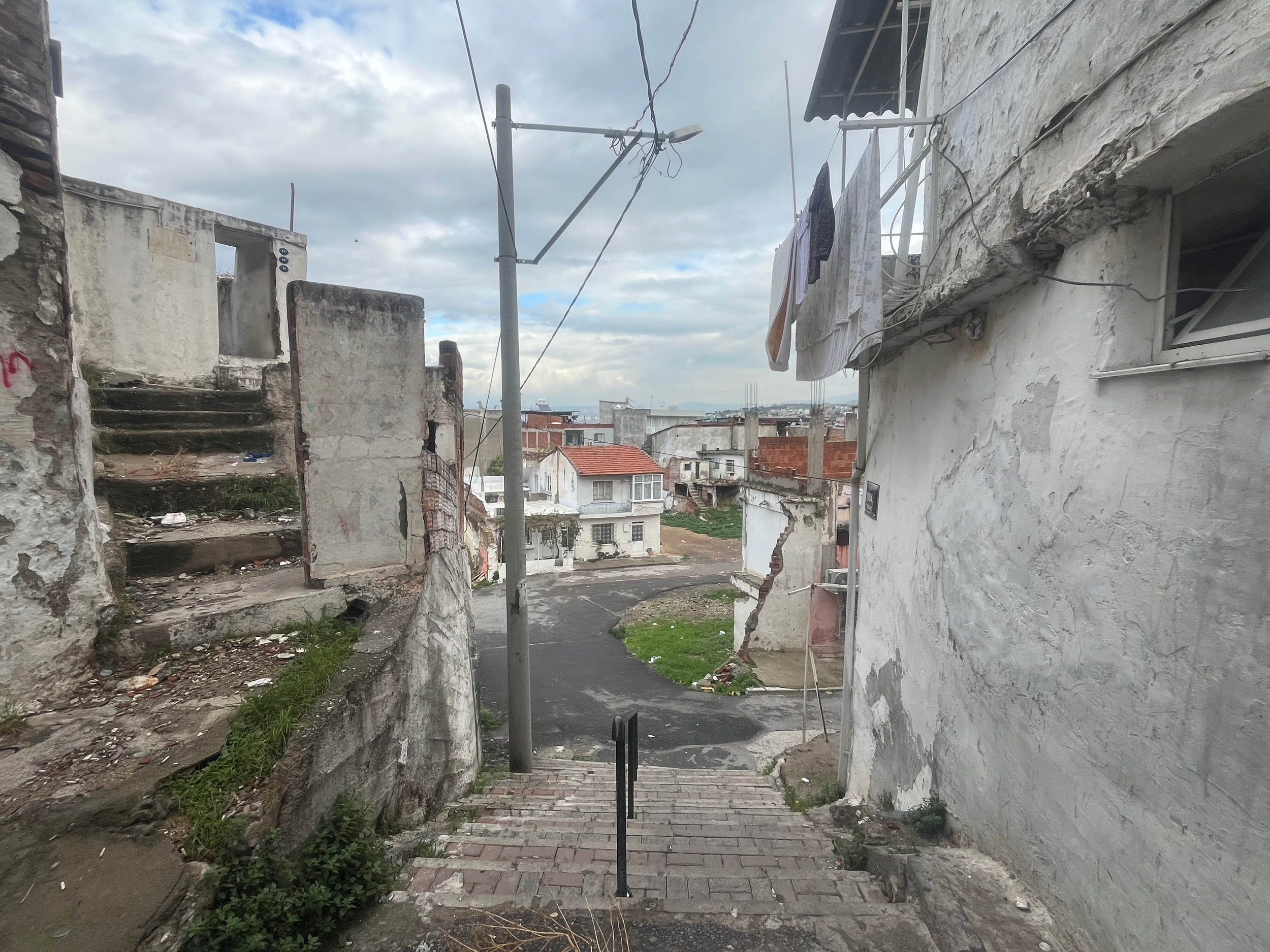
The decay of the built environment makes these social changes even more apparent. Many buildings look structurally weak, with cracked walls, broken stairways, and roofs close to collapsing. The photographs taken during this visit show buildings reduced to partial ruins, which reflect years of neglect. This physical deterioration supports the idea that Basmane has become a transient space instead of a stable residential district. The lack of investment also reflects broader economic and political constraints that limit long term planning.
Together, these elements depict a neighborhood shaped by overlapping histories, rapid demographic change, and limited state intervention. Basmane’s current landscape thus offers a concentrated illustration of how global migration patterns become embedded in the urban fabric.