
Securitization without Security:
How Migration is Shaping the Global Order
notes from the field - Izmir
The Gate to Europe - Izmir
Author: Samet Apaydın
Location: Fatih, Istanbul
Date: November 30, 2025
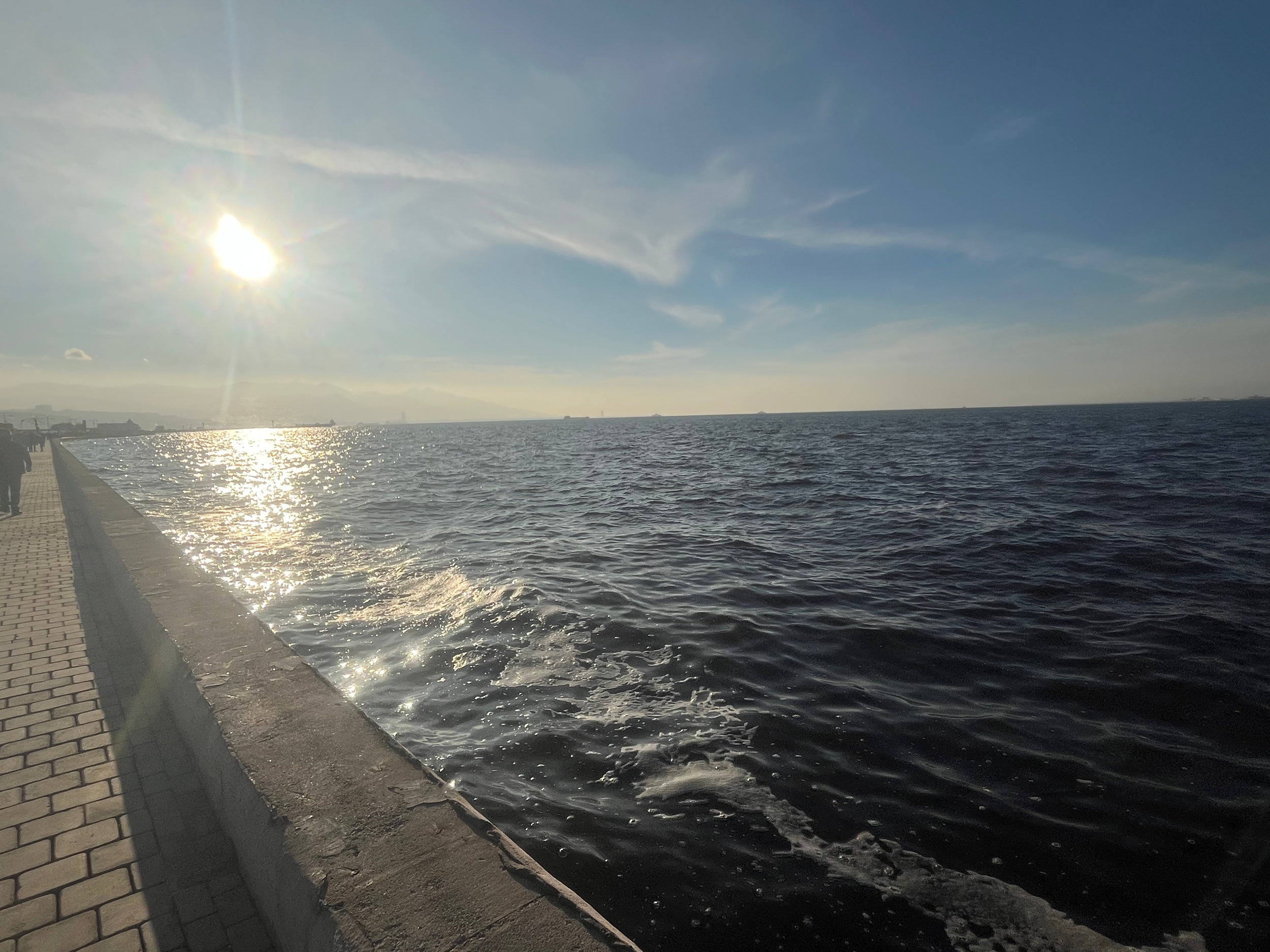
Izmir gives a strong first impression of calmness and beauty, especially along the Kordon. The sea is quiet, people walk their dogs, and the cafés are full of students and families enjoying the view. Yet behind this peaceful scene there is another reality. The same landscape that attracts thousands of visitors and locals is also a place where many migrants think about crossing the Aegean. When standing at the water and looking toward the Aegean, it becomes easier to understand why Izmir feels like both a point of arrival and a point of departure. The contrast between the relaxed atmosphere of the Kordon and the uncertainty many migrants face is very visible, especially when one knows how close the islands are.
Aside from its long history, Izmir has become a major hub for irregular migration. Geography plays a large role here. Izmir is very close to several Greek islands, and the distances show how connected the region is. The nearest island is Chios, only around seven kilometers off the coast of Çeşme and visible on clear days. Further south, Samos is about one and a half kilometers from the Turkish shore at its closest point near the Dilek Peninsula. Lesbos is also near, less than thirty kilometers west of Ayvalık. These short distances once reflected cultural ties, but today they show the city’s central position in the irregular migration routes of the Aegean.
Izmir’s Migration Economy

Over time, an entire economy linked to irregular migration has emerged in Izmir. Shops selling life vests, waterproof bags, and survival equipment had long stood next to each other, but during my visit many of these shops were no longer present. Small and cheap hostels in the back streets give temporary shelter to migrants waiting for their chance to cross. During fieldwork, this change was visible in the everyday practices of the city. Groups of young men walked along the coast and in the side streets, some speaking Arabic or Urdu, others blending into the crowd. Even without seeing an active smuggling operation, signs of movement were everywhere.
Regional Dynamics
According to FRONTEX, the eastern Mediterranean route, which is dominated by departures from Türkiye, recorded 885,386 irregular arrivals in 2015. This broke all previous records. The intensity of movement, not only the humanitarian suffering, pushed the EU and Türkiye to sign the 2016 EU and Turkey Statement. Under this agreement, the Turkish government accepted to reduce irregular migration toward Europe in exchange for financial assistance and the promise of visa liberalization for Turkish citizens. The latter has still not been achieved. This form of cooperation continues to influence local practices and political debates in Izmir today.
Migrant Presence in the City
At the peak of arrivals, the number of Syrians under temporary protection reached around 150,000, which was about 3.5 percent of the population in 2022. Today, a little over 100,000 Syrians remain in the city, while thousands have returned either voluntarily or under various forms of pressure. Still, the remaining population continues to shape the social and cultural atmosphere of the city center. Even in areas like Alsancak, usually known for tourism and leisure, the presence of migrants is part of daily life. One sees them working in restaurants, walking with families in parks, or waiting at bus stops.
Another visible change during my visit was the effect of increasing return movements. Many Syrians who once ran small cafés, barbershops, and grocery stores have either left voluntarily or felt pushed to return. In some neighborhoods, half empty streets and closed shops now reflect this shift. Several Syrian cafés now remain closed. Their signs still hang above the doors, but the shutters are pulled down. These closures are not only economic losses but also signs of a shrinking community. They show how return policies, political debates, and personal decisions slowly reshape the social landscape of Izmir, leaving behind traces of lives that have moved elsewhere.
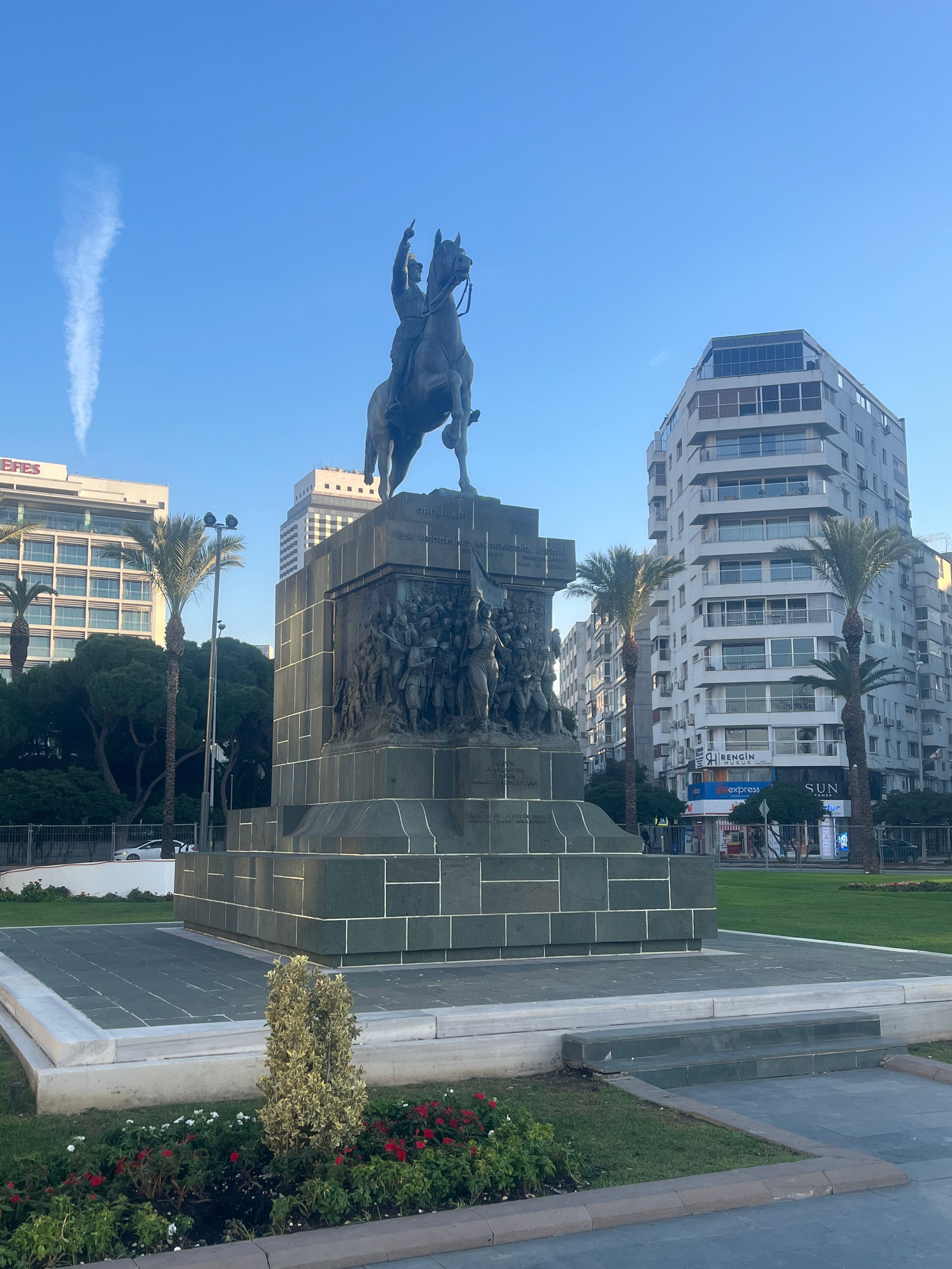
Before leaving Alsancak, I passed by the well known statue of Atatürk with the phrase translated as “Armies, your first target is the Mediterranean.” The monument is a reminder of Izmir’s importance in the final stage of the Independence War and its place in the collective memory of the early Republic. For many, the city symbolizes both a gateway to the Aegean and a center of secular and modern identity in Türkiye. Seeing this statue in the middle of today’s diverse and changing urban landscape created a strong contrast for me. Izmir continues to carry layers of history while adapting to new social and demographic realities.